
"Do I still have to fill out the disclosure form if I'm selling as-is?" It's one of the most common questions we hear. The short answer in South Carolina: an as-is sale doesn't automatically remove the disclosure statement. It can be skipped only when both sides agree in writing or another exemption in the law applies. And whatever happens with the form, you shouldn't hide a problem you know about. Here's how it works.
This is general information, not legal or tax advice. Ask your own South Carolina attorney how the disclosure rules apply to your sale.
What the SC disclosure form is
South Carolina's disclosure law is SC Code §27-50-10 and following. It covers sales of residential property with one to four dwelling units, as well as installment land contracts and lease-options (§27-50-20). The owner gives the buyer a written Residential Property Condition Disclosure Statement on the SC Real Estate Commission's form (§27-50-40).
The form walks the owner through the home's condition item by item, including HOA details (§27-50-40(A)(9), added in 2018) and, since 2023, a set of flood questions. Where the owner doesn't want to make a statement, the form allows a "no representation" answer.
Is there an as-is or investor exemption?
No. The law has no exemption just because the house is sold as-is or the buyer is an investor. A sale to a cash buyer like us is covered unless one of the exemptions in §27-50-30 applies.
"As-is" is still allowed. §27-50-110 permits agreements to sell real property "as is," and the form lets an owner mark "no representation" on items (§27-50-40(B)). But the Commission's form warns that an owner who knows of a problem and fails to disclose it may be liable for actual damages, court costs and attorney fees, and that choosing "No Representation" does not waive that liability. §27-50-65 says the same for knowingly false, incomplete or misleading disclosures.
Waiver by written agreement
One exemption fits many as-is cash sales: under §27-50-30(13), the statement isn't required when both parties agree in writing not to complete it. It has to be mutual and in writing. One side can't simply decide the form doesn't apply.
Two other points from the statute:
- If the form isn't delivered, that doesn't void the contract or delay the closing (§27-50-50(B)).
- There's no duty to disclose a death on the property, an occupant's non-transmissible illness or sex-offender registry information (§27-50-90). Lying in answer to a direct question is still actionable.
Other exemptions in §27-50-30
The statute lists 15 kinds of transfers that don't need the statement. The ones Charleston-area sellers most often ask about:
- Transfers under a court order, including estate administration, foreclosure sales, bankruptcy and receivers.
- Transfers by a fiduciary administering a decedent's estate, guardianship, conservatorship or trust, which can include a personal representative selling an inherited house.
- Transfers between co-owners, to a spouse or lineal relatives, and between spouses under a divorce decree or marital property order.
- Transfers for failure to pay taxes, and sales at public auction.
- The first sale of a dwelling that has never been lived in.
Whether one of these fits your sale is a question for your attorney. If you're selling an estate house, the estate's attorney will know.
The 2023 flood questions
Since June 1, 2023, the Real Estate Commission's form includes detailed flood questions. The statute itself wasn't changed; the update came through the Commission's form. The current version (effective 6/2023, updated 6/2025) asks about:
- Fire, smoke or water problems, including whether any structure has flooded from rising water or water intrusion, during your ownership.
- Erosion, and erosion-control structures such as a bulkhead, seawall or sandbags.
- Flood hazards, wetlands, flood zones or flood risk.
- Whether the property has NFIP or private flood insurance.
- Flood insurance claims, with dates, repairs and amounts.
- Flood repairs not filed with insurance, with amounts.
- Federal flood disaster aid received from FEMA, SBA or HUD, with amount and purpose.
- Beach nourishment assessments.
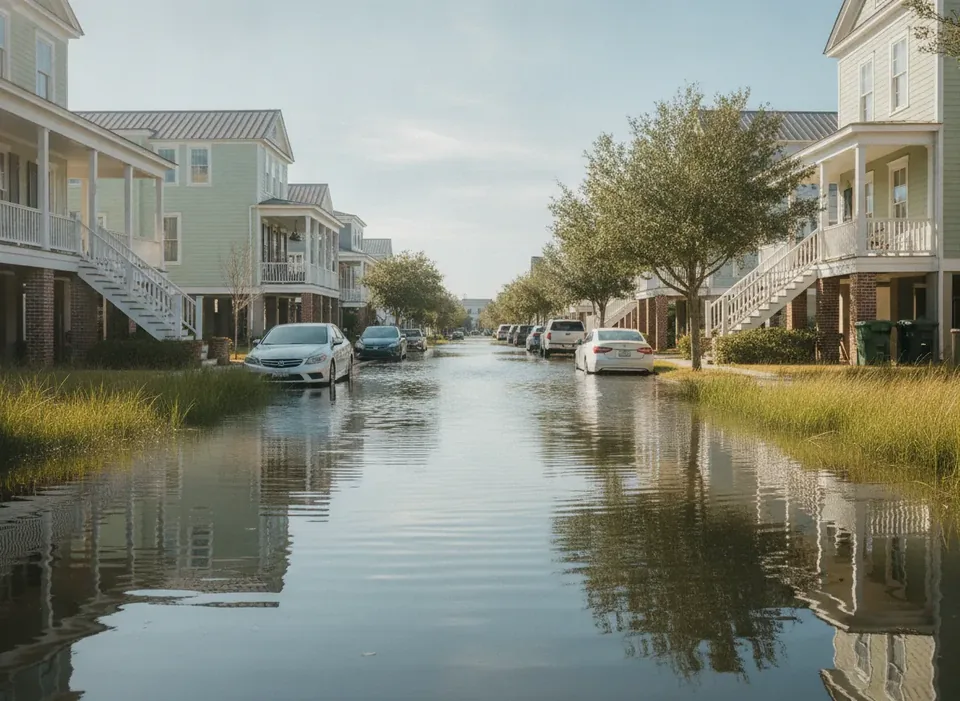
These matter around Charleston. The National Weather Service counted about 89 tidal flood days at Charleston Harbor in 2019 and about 52 in 2025, and Hurricane Irma pushed the harbor to 9.92 feet. If your house has taken water, gather your claim records and repair receipts before you sell. Our post on flood disclosure and king tides goes deeper.
Lead paint: a separate federal rule
For homes built before 1978, the federal lead-based paint disclosure rule applies to the sale. It's separate from South Carolina's form, so agreeing to skip the state form doesn't skip it. That reaches a lot of Charleston houses. In ZIP 29407 in West Ashley, the median home was built in 1971 and 67.5% were built before 1980 (American Community Survey 2024 5-year estimates). The Town of James Island's median year built is 1970. If your house is that age, expect the lead-paint paperwork at closing. The EPA's real estate disclosure page (epa.gov/lead/real-estate-disclosure) explains the rule.
How we handle disclosure when we buy
We buy as-is: no repairs, no cleaning, and you can leave what you don't want. That doesn't mean "no disclosures." In each sale we either:
Use the SC form
You complete the Commission's statement, answering "no representation" where that's honest, or
Agree in writing to skip it
Both of us sign a mutual written agreement not to complete the form under §27-50-30(13).
Handle lead paint separately
For pre-1978 homes, the federal lead-paint disclosure is completed either way.
Either way, tell us what you know: past floods, roof leaks, foundation cracks, termites. We price as-is, so known problems are already part of our offer. We look at the condition, our repair estimate, comparable sales and what we need to resell. Our cash offer will usually be less than what you might get listing with an agent after repairs. That's the trade for speed, certainty, no repairs and no fees. Use our cash offer vs. listing calculator to compare, and feel free to get an agent's opinion too.
We make a written cash offer within 24–48 hours of seeing the house or getting the details we need, and we can close in as little as 7–14 days when the title is clear, at a South Carolina attorney's office on the date you choose.
Related reading
Disclosure questions come up most with flood-damaged houses, houses that need repairs and inherited houses, where the seller may not know the home's history. We buy across the area, including West Ashley.
Ready to see an as-is number? Get your cash offer or call Call (727) 300-6656.