
If you live in a low-lying part of Charleston, you know the king tide calendar. Some streets go under on a sunny morning, and some garages take on water during storms. When it is time to sell, two questions come up fast: what do I have to tell a buyer about flooding, and will anyone buy the house as it is? This post covers how often Charleston floods, what South Carolina's disclosure form asks since 2023, what changes (and what doesn't) when you sell to a cash buyer, and your options.
This is general information, not legal or tax advice. Disclosure duties depend on your facts. If you're unsure how to answer a question on the form, ask a South Carolina real estate attorney.
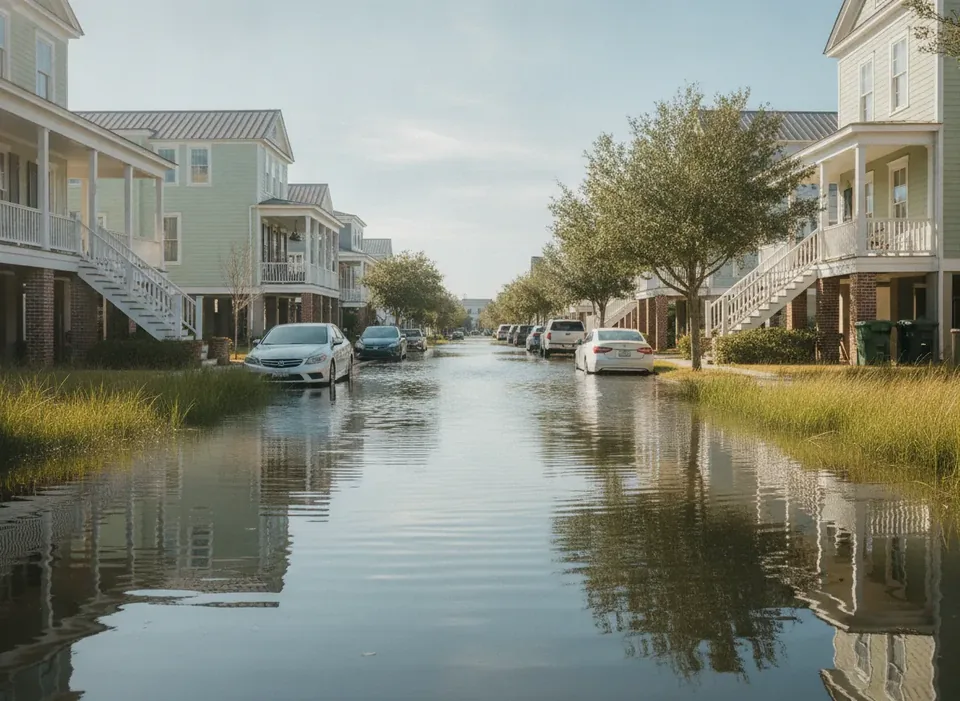
How often does Charleston flood at high tide?
Tidal flooding has become a regular event. The National Weather Service in Charleston uses 7.0 feet (MLLW) at the Charleston Harbor gauge as minor flood stage and 8.0 feet as major. By its count, the harbor saw fewer than 10 coastal flood events a year in the 1980s, more than 40 a year in the 2010s, and an average of 57 a year since 2020.
- 2019 set the record with 89 coastal flood events, as the Post and Courier reported from NWS figures.
- 2025 had 52 tidal flood events, the second straight year of decline (Post and Courier, from NWS figures).
- Storms push water much higher: Hurricane Matthew reached 9.29 feet at Charleston Harbor in 2016 and Irma reached 9.92 feet in 2017 (NWS).
- The long trend is up: NOAA measures relative sea level at Charleston rising about 1.38 inches per decade from 1901 to 2025.
King tides, the biggest tides of the year, are when many of those flood days happen. A street that floods a few mornings a year is something buyers ask about, and the disclosure form now asks too.
What South Carolina's disclosure form asks about flooding
South Carolina sellers of homes with one to four units generally must give buyers the Residential Property Condition Disclosure Statement. The law itself (SC Code §27-50-40) wasn't amended to add flooding. Instead, the SC Real Estate Commission's form, effective June 1, 2023, added flood questions. The current form asks about:
- Water problems, including whether any structure on the property has flooded from rising water, water intrusion or otherwise, during your ownership.
- Erosion, and erosion-control structures such as bulkheads, seawalls or sandbags.
- Flood hazards, wetlands, flood hazard designations, flood zones or flood risk.
- Whether you carry public (NFIP) or private flood insurance.
- Flood insurance claims, with dates, repairs and amounts.
- Flood repairs not filed with insurance, with amounts.
- Federal flood disaster aid received (FEMA, SBA or HUD), with the amount and purpose.
- Beach nourishment assessments.
The form warns that an owner who knows of a problem and fails to disclose it may be liable for actual damages, court costs and attorney fees, and that checking "No Representation" does not waive that liability.
Does selling to a cash buyer change your disclosure duty?
No, not by itself. South Carolina's disclosure law has no exemption for investors or as-is sales. The form can be skipped only if both buyer and seller agree in writing not to complete it (§27-50-30(13)), or if another listed exemption applies, such as a probate or court-ordered sale. South Carolina does allow a sale "as is" (§27-50-110), but as-is is about repairs, not about hiding known problems. Federal lead-paint disclosure also applies to homes built before 1978.
So be wary of any buyer who tells you disclosures don't matter. We never say that. We buy flood-affected houses as-is, and we would rather know the history up front so our offer already reflects it. Our post on seller disclosure in an as-is sale goes deeper.
Records worth gathering before you sell
- Dates the house or garage took on water, and how high.
- Flood insurance policies and any claims, with payout amounts.
- Invoices for flood repairs, insured or not.
- Letters about FEMA, SBA or HUD aid, with amounts.
Substantial damage, buyouts and drainage projects
For homes in a FEMA Special Flood Hazard Area, the City of Charleston applies the 50% substantial damage and substantial improvement rule: a heavily damaged flood-zone house may have to be brought fully into floodplain compliance, for example by elevating it. That can turn a repair into a much bigger project, which is one reason some owners sell instead.
Some owners also look at buyouts. In West Ashley's Church Creek basin, the City bought out and removed 32 flood-prone townhomes at Bridge Pointe, and as of 2026 the City says it has acquired 46 properties in James Island and West Ashley through its voluntary buyout program. Those programs rely on FEMA funding, favor repeatedly flooded and substantially damaged homes, and have no set timeline. If your home might qualify, it is worth asking the City. On James Island, a $4.5 million final phase of the Central Park basin drainage project aims to cut off high-tide impacts near Riley Road, with completion expected by the end of 2027 (Live 5 News).
Selling a house that floods, as-is
If you would rather not wait on a buyout, a drainage project or a round of repairs, we buy flood-affected houses as-is across the Charleston area, including James Island and West Ashley:
- No repairs, no mold cleanup, no cleaning. Leave what you don't want.
- A written cash offer within 24–48 hours of seeing the house or getting the details we need.
- Closing in as little as 7–14 days when the title is clear, on the date you pick.
- No fees or commissions, and we pay the closing costs. You still pay off your mortgage and any liens from the proceeds.
Our cash offer will usually be less than what you might get listing with an agent after repairs. That's the trade for speed, certainty, no repairs and no fees. Use our calculator to compare, and feel free to get an agent's opinion too.
Learn more about selling a flood-damaged house in Charleston or selling a house that needs repairs. When you are ready, request your cash offer or call Call (727) 300-6656.
Frequently asked questions
Do I have to disclose flooding when I sell my house in South Carolina?
Generally yes. Since June 2023, the SC Real Estate Commission's disclosure form asks whether structures flooded during your ownership, about flood zones and flood risk, insurance, claims, unfiled repairs and FEMA, SBA or HUD aid. There is no exemption for cash or as-is sales unless both parties waive the form in writing. This is general information, not legal advice.
Does a seller have to disclose a flood zone?
The current South Carolina form asks about flood hazards, flood hazard designations, flood zones and flood risk, so answer based on what you know. If you're unsure of your zone, check the FEMA flood map or ask the city or county floodplain office. Knowingly leaving out a problem can make an owner liable for damages. This is general information, not legal advice.
Can I sell a house that floods as-is?
Yes. South Carolina allows as-is sales, and we buy flood-affected houses in the Charleston area without repairs or cleanup. As-is means you aren't fixing anything, not that the flood history goes unmentioned, so you still disclose what you know. Our cash offer reflects the condition and will usually be below a repaired, listed price.